The Governor’s proposed 2026-27 budget provides few details about how the state will honor its previous commitments to fund transit in the coming years. There’s some discouraging news for key funds, and a few critical funding opportunities for Association members. Here’s what we know.
By Arianna Smith
Managing Editor
Transit California
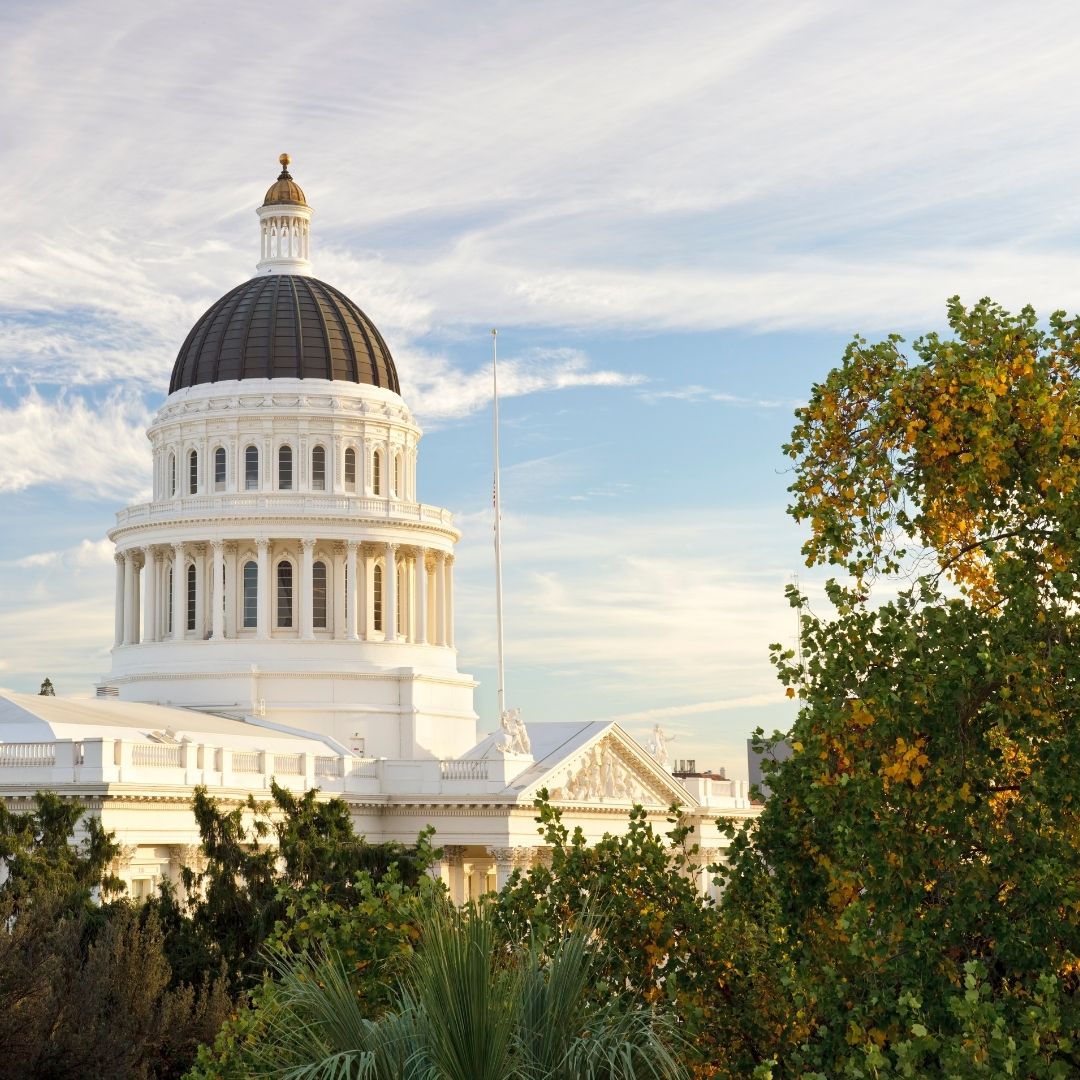
On January 9, Governor Newsom released his proposed 2026-27 state budget, where he projected a $2.9 billion deficit and proposed a variety of spending cuts, delays, and deferrals.
And that deficit prediction is the optimistic one.
In late 2025, Legislative Analyst’s Office (LAO) projected an $18 billion deficit; the LAO notes that the Governor’s proposed budget reduced the deficit by relying on a potentially risky prediction about revenues. “Several historically reliable signs suggest the stock market is overheated and at high risk of reversing course into a downturn in the next year or so,” stated the LAO in its proposal overview of the Governor’s budget. “Should a stock market downturn occur, income tax revenues would fall considerably. These risks are severe enough that not incorporating them into this year’s budget, as the Governor proposes, would put the state on precarious footing.”
The coming months will reveal whether the revenue intake and budget deficit are closer to the Governor’s fiscal assumptions, or those of the LAO. In the meantime, the Legislature is getting to work crafting the main Budget Bill and trailer bills, which will include the Legislature’s own spending priorities and cutting decisions.
For transit agencies, much remains unclear. Funding questions left open during the 2025-26 budget approval haven’t been fully answered by this year’s budget proposal; further, the budget is completely silent on whether several funding commitments made in 2023, 2024, and 2025 will be honored this coming fiscal year.
“Currently, the Association is working to secure committed, previously negotiated funds for our programs as the Legislature fills in budget details,” said Michael Pimentel, Executive Director of the Association. “The projected deficit comes as no surprise. The extent of the deficit – and how the Legislature will respond – remains to be seen, but we know our member transit agencies should be ready to activate as part of our Association advocacy efforts.”
What we know: Cap-and-Invest funds are flagging
The budget proves what the Association warned of last year: the weak market for Cap-and-Invest allowances could mean less funding for key transit programs.
Two transit programs designed to fund transit projects that reduce greenhouse gas emissions, the Transit and Intercity Rail Capital Program (TIRCP) and the Low Carbon Transit Operations Program (LCTOP), are at risk of a reduction in proposed funding. TIRCP funds capital improvements to modernize intercity, commuter, and urban rail systems, as well as bus and ferry transit systems. LCTOP supports new or expanded bus or rail services and expands intermodal transit facilities, with priority given to disadvantaged communities. Until this year, the two programs were funded with fixed percentages of Greenhouse Gas Reduction Fund (GGRF) money that was generated by the auction of carbon allowances in the Cap-and-Invest program; the funding dollar amounts were higher in strong market years, and lower in weak market years.
Last year, SB 840 established tiers of funding priority for Cap-and-Invest dollars: Tier 1 guarantees $1 billion for the California high-speed rail project, Tier 2 provides $1 billion for discretionary expenditures, and Tier 3 includes a variety of large-scale climate program, including TIRCP and LCTOP.
Additionally, SB 840 changed the percentages that TIRCP and LCTOP previously relied on to annual flat dollar amounts: $400 million annually for TIRCP and $200 million for LCTOP. These amounts would only be available if the Cap-and-Invest auction for allowances generated enough revenue for GGRF to fully fund all Tier 1 through Tier 3 obligations.
Last year, the market was weak, and the auction did not generate enough revenue for full funding. Under SB 840, if, after meeting all Tier 1 and Tier 2 obligations, there is insufficient funding in the GGRF to meet Tier 3 obligations at their full funding levels, all Tier 3 funding levels are decreased proportionally across the programs.
Anticipating continually weak auctions in the year ahead, under the Governor’s proposed budget, the two programs are proposed to receive just $283 million and $141 million respectively in FY 2026-27 from GGRF – amounts that fall far below the respective $400 million and $200 million annual flat amounts agreed upon in 2025. Under the previous formula, the TIRCP and LCTOP received on average $301.1 million and $144.56 million annually, respectively.
“Last year, the Association warned explicitly of this possibility during the negotiations around the Cap-and-Invest program. Because the auction failed to bring in at least $4.2 billion, transit agencies now face a funding environment that is not really any better than it was under the percentage formula – and with the possibility of weak markets in future years, that funding could decline even further,” said Pimentel.
What we don’t know: More questions than answers on discretionary funds, SB 125 commitments, and the Bay Area Transit Loan
Some of the discretionary $1 billion in Tier 2 GGRF funds pertain to transit interests, but details are sparse. The Governor proposes to use three-quarters of the funds – $750 million – to support CalFire, and the remaining $250 million is proposed to be used for purposes previously identified in SB 840. These expenditures include: $125 million in FY 2026-27 for transit passes, $85 million for climate research and innovation, $25 million for the UC Climate Center; and $15 million for the Topanga Park. No further details on any of these projects are provided in the budget proposal.
In previous budget years, the state committed to schedule appropriations from GGRF for the Zero-Emission Transit Capital Program (ZETCP) at $230 million in FY 2026-27 and $460 million FY 2027-28. ZETCP was originally established in 2023 under SB 125, and transit agencies use its funds to replace aging fleets with zero-emissions vehicles, updating fueling and charging infrastructure, and Zero-Emission Mobility Programs. The budget fails to move forward this scheduled appropriation of $230 million from the GGRF to the SB 125 program.
Finally, uncertainty looms over the details of last year’s initial agreement for a Bay Area Transit Loan of $750 million for four Bay Area transit agencies facing fiscal crises (AC Transit, BART, Caltrain, and SF Muni). The agreement was ultimately memorialized in last year’s budget bill in very general terms. This year’s proposed budget currently includes similarly high-level language proposing "statutory changes to authorize the Metropolitan Transportation Commission (MTC) to provide short-term loans to transit agencies facing cash flow challenges, preserving essential services for Bay Area riders." Additional details in a budget trailer bill will be available in the coming weeks.
For more details about the Governor’s budget proposal, see the Association’s January 9 funding update.
What’s next
The Association has identified key budget priorities, which will be included in a budget letter, released next month. The Association’s advocacy will continue to highlight transit agencies’ need for funding certainty amidst a potentially bleak economic forecast. The Association will prioritize securing previously committed $230 million in SB 125 funds for ZETCP, engaging on details for the $125 million marked for transit passes, protecting TIRCP and LCTOP’s funding sources, and securing resources for zero emission transition activities.
The Association will also pursue an extension of statutory relief measures, including options that hold shield transit agencies from financial penalties for failing to meet farebox recovery ratio requirements and efficiency requirements.
Now that the Governor has released his final proposed budget, Assembly and Senate Budget Subcommittees will meet to consider the proposal and modify it with the budget priorities of the Legislature. In the coming months, Association leadership will focus on advocacy strategies to work with the Chair and members of the Senate Budget Subcommittee No. 5 on Corrections, Public Safety, Judiciary, Labor and Transportation (led by Chair Laura Richardson), as well as the Assembly Subcommittee No. 4 on Climate Crisis, Resources, Energy and Transportation (led by Chair Steve Bennett).
In mid-May, the Governor will release his “May Revise” proposed budget update based on the state’s updated revenue forecast; better-than-expected revenues could signal more or at least steady funding for transit, while worse-than-expected revenues could result in additional funding cuts. The legislation that enacts the main budget, the Budget Bill, must be passed by the full Legislature by June 15, but the Legislature often passes several budget trailer bills with additional details later in the session.
As the Budget Subcommittees move forward with budget negotiations this spring, watch for guidance, talking points, action alerts, and public affairs content from the Association’s Advocacy and Communications Teams. The Association will lead member agencies to transmit a consistent, powerful message to lawmakers.