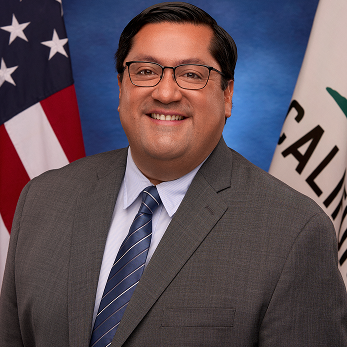
Transit California sat down with Bay Area State Senator Jesse Arreguín.
Transit California: You represent a densely populated East Bay district that includes parts of the Counties of Alameda, Contra Costa, and San Francisco. What are some transit challenges and opportunities you see for your district?
The biggest challenge facing transit in the Bay Area is an imminent fiscal cliff due to declining farebox revenues and the loss of one-time emergency funding. That is why I partnered with my colleague Senator Scott Wiener to secure $590 million in a short-term bridge loan to support Bay Area transit agencies, and co-authored SB 63 to allow the Bay Area to consider a regional sales tax measure for transit operations. Additionally, threatened cuts to federal funding for transit projects impact long planned, and major regional projects. That is why it is essential that we honor the agreement reached last year in the passage of the Cap-and-Invest legislation, SB 840, to continue funding for SB 125 transit operating funds, the Zero-Emission Transit Capital Program (ZETCP) and TIRCP and Low Carbon Transit Operations Program (LCTOP). Senator Wiener and I are championing the restoration of these critical operating and capital funding programs in the FY 26-27 budget. Once we can stabilize Bay Area transit, we have an incredible opportunity to coordinate transit schedules, improve transfers and make the experience seamless and affordable, to get riders back on our buses and trains.
Transit California: Because of a loss of federal pandemic shutdown funding and a slow recovery of daily ridership, Bay Area transit operators are facing budget shortfalls that could require dramatic cuts to services. You led the legislative effort to secure state funds, which ultimately resulted in an emergency loan of $590 million to the agencies. Why and how did you successfully champion these critical funds?
Transit is the lifeblood of the Bay Area’s economy and key to our efforts to combat climate change. Without stable and reliable transit, workers will be unable to get to work, students won’t get to school and working families and seniors will suffer. As someone who relies on public transit, I know how essential reliable, safe and accessible transit systems are. While it is true that some transit agencies continue to have ridership levels below what we saw pre-pandemic, recent investments by transit agencies to address ridership concerns have helped bring back riders. The emergency loan is a major victory for our region’s transit operators, workers, and the communities that depend on public transit to get to work and school
Transit California: You are the Senate co-author of AB 1837 (Mark González), the Association-sponsored legislation to extend an existing authorization for transit agencies to install parking enforcement cameras on buses, with the intent to stop drivers from parking their cars in bus lanes. Can you tell us more about the impact this legislation could have?
Cars blocking bus lanes and stops isn’t just a pet peeve, it has impacts on transit reliability and public safety. We’ve all seen it, drivers who treat transit infrastructure as a free parking spot, and they do this because they think they will get away with it. AB 1837 sends a clear message that we will not tolerate this disruptive behavior. This bill will help improve on-time performance and accessibility – two factors that will help grow ridership. Importantly, this bill addresses privacy by ensuring that data records and retention are not improperly used.
Transit California: In your role as a member of the Senate Committee on Transportation, which considers a wide range of policy bills related to public transit, intercity rail, and mobile sources of air pollution, as well as bills that affect our state highways and local roads, what transit policy issues do you see as the will be of greatest priority this legislative session? 
While it’s hard to pick out a singular issue that is the greatest priority, given that there are so many topics under the umbrella of transit policy, one of the most topical issues is the price of gas, which has been compounded by the War in Iran. During the first month of the war, the average price of gas across the country skyrocketed to nearly $4 a gallon, an increase of over $1. And we all know that gas prices in California are even higher than national averages. This sticker shock may change the way people commute, ditching expensive cars for cheaper public transit. I also believe we should use this moment to double down on clean energy and electric vehicle infrastructure. This war has demonstrated that our reliance on oil is dangerous, with implications that can derail economic growth.
Transit California: You are the author of SB 1408, which would allow CCTA to place a sales tax measure on a future ballot. If signed into law, how would this bill affect local transit agencies and their riders?
SB 1408 builds upon the accomplishments in improving transit across Contra Costa County that was initially approved by voters under 1988’s Measure C, and its renewal under Measure J in 2004. Measure J, which sunsets in 2034, has been instrumental in advancing several key transit projects in the County, including the expansion of BART to Antioch and increased paratransit options for seniors and people with disabilities. With SB 1408, voters will be empowered to renew the sales tax, furthering high-quality and reliable transit that residents rely on.
Transit California: You have led several legislative efforts to address the housing and homelessness crisis in your district and across the state. From your perspective, how do you see transit fitting into the proposed solutions?
California recognizes the intersection of housing and transit, and how tying them together can provide economic benefits at both an individual and regional level. Last year’s passage of SB 79 is a reflection of that, making it easier to build denser housing around major transit hubs. Before my time in the State Legislature, AB 2923 was passed in 2018, which enabled BART to build housing on its property near BART stations. In my district, several transit-oriented developments are underway at BART stations in Berkeley, El Cerrito, and Oakland. It’s critical that we incentivize the creation of affordable housing near public transit, as 45% of Bay Area transit riders have a household income of under $50,000. Both housing and transit connect to issues around affordability and packaging them together can increase positive outcomes in supporting the needs of lower income families.
Transit California: You served as Mayor of the City of Berkeley for eight years and you were the first Latino elected to the position. How did this experience in local government inform your leadership on transit issues?
Being a mayor of a city gives you a front row seat to how transit is interwoven into day-to-day society. I recall working on issues that may seem small but can have major consequences, such as working to align bus schedules with school schedules, addressing the needs of constituents who rely on public transit that was impacted during the pandemic, or balancing the needs of commuters, businesses, and residents on the optimal route for new bike lanes. Then there are other debates that are a microcosm of broader issues such as overseeing proposals on transit-oriented development, where the question of state vs local authority plays out in real time. These experiences have helped me get a better understanding of the more personal stories and impacts behind the actions and policies we make as legislators.
Transit California: What is the best way for transit agency representatives to get in touch with your office on legislative issues?
My office continues to be open and accessible to anyone. Feel free to phone, email, or stop by my office and my team will be happy to assist. I’m proud of the partnerships I have made with transit agencies, as we both share the goal of supporting our constituents’ transit needs.