LA Metro reinforces Rail Safety Month; SFMTA celebrates Transit Month; BART celebrates crime reduction at one-year anniversary of fare gate installation; San Diego MTS sets new ridership record; Ventura County Tap2Ride fare payment now available; BART Police Civilian Review Board shows support for riders with autism and other disabilities.
By Transit California Staff
LA Metro Reinforces Rail Safety Advice “Never Train Surf. Safety Begins with You.” During Rail Safety Month
To commemorate Rail Safety Month this September, the Los Angeles County Metropolitan Transportation Authority (Metro) is reminding everyone, “Never Train Surf. Safety Begins with You,” and encourages the public to practice safe behavior around Metro trains and tracks.
“Everyone deserves to get where they’re going safely, and Rail Safety Month is an opportunity to remind Angelenos that a few simple choices can save lives,” said Metro Board Chair and Los Angeles Mayor Karen Bass. “Metro is working to build a culture of safety that protects riders, pedestrians, drivers, and everyone who shares our transportation system.”
Metro continues to see dangerous incidents involving people riding on the outside of trains, between rail cars, behind trains or standing on couplers — a practice commonly known as train surfing. To help discourage this behavior, Metro is releasing a new Safetyville animated video highlighting the serious risks and encouraging riders to make safe choices.
Metro will promote the new Safetyville video throughout the month on its social media channels, including YouTube, Instagram, Facebook, and TikTok. The popular animated series uses fictional characters to illustrate the consequences of unsafe behavior around trains and reinforces simple actions that can help prevent injuries and save lives.
“We all have a role to play in creating a safer transit experience,” said Metro CEO Stephanie Wiggins. “Public awareness is a big part of safety, and with our new ‘Never Train Surf’ video, we’re educating riders about the serious dangers of unsafe behavior around trains and reinforcing the simple actions that can help keep everyone safe.”
Throughout Rail Safety Month, rail safety messages will appear in English and Spanish at select Metro rail stations and bus stops as well as on wrapped light rail trains operating along the A, E and K Lines. Metro will also participate in community events throughout Los Angeles County to share rail safety information and encourage the public to follow these important safety tips:
Metro’s Rail Safety Education Program takes a proactive approach to rail safety by providing ongoing, year-round education and awareness through community workshops, school presentations and travel orientations. Serving neighborhoods along Metro’s A, E, and K Lines, these efforts provide communities with the knowledge and tools to make safe choices around the rail system, increase awareness of rail safety, prevent unsafe behavior, and reduce rail-related incidents and injuries.
To learn more, visit metro.net/railsafety.
SFMTA: Celebrate Transit Month on Muni
Muni moves San Francisco all year long. But September is special because it’s Transit Month!
SFMTA kicked things off with a rally featuring Mayor Daniel Lurie and Director of Transportation Julie Kirschbaum on the steps of San Francisco City Hall. SFMTA has a lot to celebrate this year:
This is, however, a challenging time for SFMTA. SFMTA recently balanced a $307 million budget deficit, thanks to a state loan and agency cost savings, but they still face an unprecedented financial crisis. So, it’s more important than ever to highlight the essential service that transit provides.
Here are the special events, activities, and plenty of reasons that folks got on board this month. Everyone was invited to revel in the joys of transit, even if they were trying it for the first time.
Muni’s Bussin’ Bingo
Bussin’ Bingo combines local flavor with transit pride. All month long, use Muni to visit participating businesses and organizations and collect stamps and stickers for your bingo card. You can head to your favorite neighborhood or discover a new one on a route you’ve never taken before.
How to play: Pick up a bingo card at any of the participating businesses or download and print your own. Then start collecting!
Read & Ride
What’s better than getting lost in a good book? Getting lost in a good book on Muni.
Turn travel time into reading time with Read & Ride, a brand-new Transit Month challenge from Muni and the San Francisco Public Library. Just log the time you spend reading while on Muni. Once you reach 10 hours, you’ll earn a limited-edition Read & Ride bookmark. Need a book? Check out the Transit Month Reading List, featuring some of SFMTA’s favorite books. Find your next great read and make your ride a page-turner. There’s more information on the Read & Ride webpage (SFMTA.com/ReadAndRide).
T Third Ride Along
The T Third is one of San Francisco’s most important transit lines. And the T Third Improvements Project (SFMTA.com/TThird) is making the line more reliable to help you get to your destination more quickly. You can join SFMTA for a special T Third ride-along. Just sign up here to get an inside look at the improvements and what they mean for your ride.
Muni Heritage Weekend
Take a ride through San Francisco’s transit history during Muni Heritage Weekend. Hop aboard beautiful vintage vehicles and enjoy family-friendly activities celebrating the history of SFMTA’s iconic transit system.
You can visit SFMTA’s Muni Heritage Weekend webpage (SFMTA.com/MuniHeritage) for more information.
55 Dogpatch Wine Progressive
Good wine, good neighbors and good transit? Now, those are reasons to ride. Let Muni be your designated driver during a special neighborhood wine progressive along the 55 Dogpatch route. Experience the flavor of Dogpatch without worrying about parking or driving.
Muni moves you
Muni connects people to the city and to each other.
However, SFMTA is facing the largest financial crisis in its history. Even with significant progress cutting costs, additional funding is necessary to keep Muni and other transit services running.
You can read more on SFMTA’s budget gap webpage (SFMTA.com/BudgetGap).
This Transit Month, let’s all recognize the vital role transit plays in our city and invite more people to experience it for themselves.
BART: New data shows crimes against riders plummeted as BART celebrates one year since arrival of new fare gates
Decline in crime comes as ridership has increased by millions of trips per year
The number of crimes against riders per million trips has fallen 67% from the end of 2024 to the latest quarter. The crime rate is falling even as more people are riding BART. Over that same period the number of BART PD and safety-related delays fell 47% as police had to respond to fewer reported incidents.
“We knew updated, modern gates would improve the rider experience. They have been a real game changer,” said BART General Manager Bob Powers. “The new gates are at the core of what I call the ‘New BART.’ We are offering our riders a safer, cleaner, and more reliable experience than even just a year ago.”
"The data speaks loud and clear: BART's new fare gates prove without a doubt that investing to improve and modernize our public transit infrastructure pays off big time," said Libby Schaaf, President and CEO of the Bay Area Council. "BART riders want and deserve nothing less than a safe, convenient and clean system and BART has delivered. The Bay Area Council is proud of our advocacy in support of these new fare gates and our partnership with BART to help get this done.”
September marks one year since BART completed the successful installation of Next Generation Fare Gates at all 50 stations. The work was completed several months ahead of BART’s deadline to have new gates fully installed by the end of 2025.
Riders report seeing fewer instances of fare evasion. The percentage of riders who say they witnessed fare evasion during their trip is down 60%. Early indications suggest the gates are responsible for about $10 million in annual BART revenue growth through reduced fare evasion.
“New gates and our high-visibility patrols on trains and in stations are providing layers of security for our riders,” said BART Police Chief Kevin Franklin. “As reports of fare evasion drop, it frees up members of my team to respond more rapidly to emergencies in the system.”
The new gates have clear swing barriers that are very difficult to push through, jump over, or crawl under. The overall fare gate array forms a tall barrier of at least 72 inches high to deter fare evasion.
Making already highly effective gates even stronger
BART is doing ongoing work to make the new gates even more resilient against fare evaders and those who try to damage them. BART is piloting an advanced motor gear system which is designed to strengthen the gates’ resistance to repeated impacts. Gates outfitted with the new motors have been able to withstand 10,000 repeated impacts of around 926 pounds. The new motors are being tested right now at Coliseum and Pittsburg Center stations.
San Diego MTS Sets New Ridership Record, Surpassing Four Million Trolley Trips in a Single Month
July 2026 ridership marks the highest monthly Trolley ridership in MTS history and continued post-pandemic growth
While San Diego’s recent hot weather was record-breaking, the San Diego Metropolitan Transit System (MTS) was also on a record-setting hot streak. Frequent service, strong rider demand, and major event service helped MTS reach a record ridership milestone in July 2026. During the month, MTS recorded 4.1 million passenger trips on its Trolley system, marking the first time in agency history that monthly Trolley ridership has surpassed four million rides.
“Record-breaking ridership reflects the region's growing reliance on fast, frequent and reliable public transit,” said Stephen Whitburn, MTS Board Chair and San Diego City Councilmember. “More people are choosing the Trolley to get to work, school, sporting events and major destinations throughout the region. This milestone demonstrates the vital role public transit plays in keeping San Diego moving.”
July’s ridership indicates MTS’s continued recovery from the pandemic, when transit systems nationwide experienced historic declines in ridership. Since then, MTS has rebuilt ridership through investments in service, safety and customer experience, helping position the agency amongst the nation’s strongest-performing systems. In Fiscal Year 2025, MTS ridership surpassed 80 million annual passenger trips for the first time since before the pandemic, marking more than 95% of its pre-pandemic ridership. Ridership continued to grow in Fiscal Year 2026, recording 81.2 million passenger trips in the year.
“This achievement reflects years of work to make transit a more attractive option for people across our region,” said Sharon Cooney, MTS Chief Executive Officer. “Whether someone is commuting to work, attending a Padres game or heading to Comic-Con, more riders are choosing the Trolley because it offers a convenient, reliable and sustainable way to travel. Surpassing four million Trolley trips in a single month is a powerful sign that public transit is thriving in San Diego.”
The Trolley system's growth is a result in increased service frequency, major regional events, population and employment growth along transit corridors, continued demand for affordable transportation options, and the UC San Diego Blue Line extension to La Jolla and University Town Center. The UC San Diego Blue Line recorded the most ridership in July with more than 2.36 million passenger trips, followed by the Green Line with 971,266 trips and the Orange Line with 587,174 trips.
The record-setting total also includes 132,315 trips taken on the Special Event Line during Comic-Con. Even without Comic-Con ridership, Trolley ridership totaled 3,973,288 trips, making July the highest ridership month on record for MTS’s Trolley system. The previous Trolley monthly record was 3,938,761 trips in October 2024.
July 2026 Trolley ridership surpassed the previous two Julys, which recorded approximately 3.87 million and 3.92 million Trolley trips, respectively. Additionally, MTS buses recorded 3,082,492 passenger trips in July. The milestone further reinforces the Trolley's growing role as the backbone of San Diego's transit network and highlights the effectiveness of MTS's ongoing investments in frequent service, system improvements and customer-focused enhancements.
The agency’s national ranking rose from 21st before the pandemic to 13th in 2025. For a region that ranks 18th nationally in population, San Diego’s transit ridership ranks among the nation’s top 10, underscoring the system’s importance to the region it serves.
Ventura County: Tap2Ride fare payment now available on bus systems across Ventura County
Riders on seven public transit systems can easily pay fares using mobile devices and contactless debit and credit cards – no bus pass or cash required
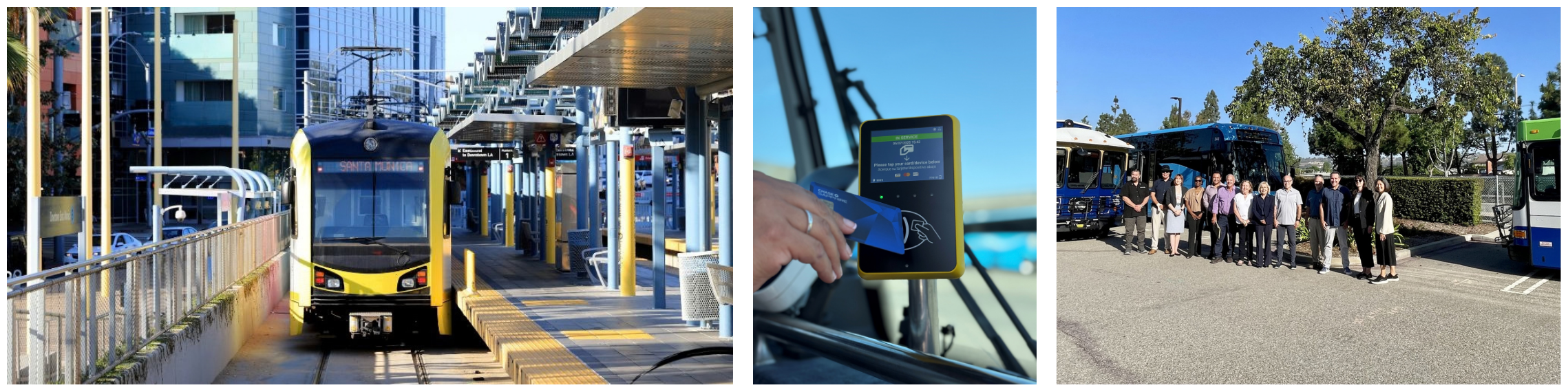
Tap2Ride, a contactless system that allows riders to pay fares with mobile devices and contactless debit and credit cards, is now available on seven public transit systems across Ventura County.
Camarillo Area Transit, Gold Coast Transit District, Moorpark City Transit, Simi Valley Transit, Thousand Oaks Transit, Valley Express and VCTC Intercity fixed-route buses now offer the Tap2Ride fare payment option, making bus travel easier and faster. There’s no need to carry exact change or purchase a bus pass before riding. Passengers can simply tap their contactless debit or credit card, mobile wallet, or smartwatch on the yellow payment reader as they board.
Tap2Ride offers additional advantages, including:
A regionwide “fare capping” discount for riders who use two or more systems. When paying through Tap2Ride, the Tap2Ride system “caps” the amount a passenger pays when riding during a set period. The cap mirrors the same discount as a 31-day pass without the upfront cost of purchasing a pass.
Regional transfers. Passengers can transfer to any bus for free within two hours when using Tap2Ride. The transfer is automatically applied to the card used to pay the fare on the first bus. No need to request a transfer slip from the bus driver.
Reduced fare benefits. Medicare card holders, people age 65 and older, and U.S. military veterans can register a debit or credit card to receive reduced fares on any bus in the county. Registration is available at the California Integrated Travel Project (Cal-ITP) website, benefits.calitp.org.
Riders without access to a bank-provided contactless card or a bank account are encouraged to seek assistance through the Bank On national platform, led by the nonprofit Cities for Financial Empowerment Fund (CFE Fund). Bank On has partnered with more than 100 bank branches across Ventura County. More information about Bank On and a full list of Ventura County partner banks can be found on the Tap2Ride page on VCTC’s website at goventura.org/affordable-banking-options.
The Ventura County Transportation Commission (VCTC), the regional transportation planning agency for Ventura County, introduced Tap2Ride on the VCTC Intercity service in June 2025 and has been collaborating with transit operators and Cal-ITP to bring the system to buses countywide.
Funding for the Tap2Ride expansion was provided by the Southern California Association of Governments (SCAG) through the Regional Early Action Planning (REAP) 2.0 program.
“As the agency responsible for coordinating transportation across Ventura County, VCTC is proud to help our transit agency partners implement the Tap2Ride system,” said VCTC Executive Director Martin Erickson. “Tap2Ride provides passengers a way to pay fares that is simple and consistent, regardless of which bus they are riding. For new and infrequent riders, Tap2Ride is an easy way to try their local public transit systems.”
“We’re excited to make riding the bus even easier and faster. With Tap2Ride, riders can simply tap their card and go, just like paying for a cup of coffee,” said Vanessa Rauschenberger, General Manager at Gold Coast Transit District (GCTD).
“This regional launch is a huge achievement for VCTC and a major milestone for Cal-ITP,” said Gillian Gillett, Chief of Data & Digital Services and California Integrated Mobility Program Manager at Caltrans. “Ventura County transit operators have worked together to leverage the State of California’s master service agreements and Cal-ITP’s technology offerings to deliver a more cohesive experience for their customers. This work demonstrates Cal-ITP’s vision for the future of transit in California – a simpler, more connected transit network that makes it easier for transit operators to provide high quality, affordable service for their customers.”
BART Police Civilian Review Board Throws Its Support Behind Blue Envelope BEEP Smart Card Proposal to Improve Police Interactions with Riders with Autism or Hidden Disabilities
Board backs OIPA effort to bring Blue Envelope concept to BART with help from Grand Prize-Winning BART Innovation Interns
The BART Police Civilian Review Board (BPCRB) is throwing its support behind BEEP — the Blue Envelope Program concept — an initiative spearheaded by BART’s Office of the Independent Police Auditor (OIPA) to adapt the nationwide Blue Envelope concept for BART. The program is designed to help BART Police officers and other frontline employees better communicate with riders who are autistic and/or who have hidden disabilities, helping make interactions safer, clearer, and more respectful.
Last year, the BPCRB unanimously voted to authorize Chairperson Dana Lang to send a letter of support to OIPA, encouraging the BART General Manager and BART Police Department to work with OIPA to move the initiative forward.
“The BART Police Civilian Review Board (BPCRB) is pleased to express its support for OIPA’s proposed Blue Envelope Program (BEEP) and encourages the BART General Manager and BART Police Department to work with OIPA to move this initiative forward,” Chairperson Lang said in the letter. “We believe the concept has the potential to make these interactions safer, more effective and more respectful for both riders and BART employees,” Lang continued.Lang also pointed to the connection between BEEP and the broader purpose of civilian oversight. “The BPCRB believes this initiative is consistent with the shared goals of civilian oversight, community engagement, transparency and continuous improvement in policing,” she said.
Bringing the Blue Envelope Concept to BART
Blue Envelope programs are designed to help improve communication between law enforcement and people whose disabilities or neurodivergence may not be immediately apparent. OIPA is spearheading the effort to adapt the concept for BART and determine how it could work within a public transit environment. The effort reflects OIPA’s broader role in bringing the public, civilian oversight and BART Police together to identify ways to improve policing and strengthen public trust.
“I believe the Blue Envelope Program can make a meaningful difference in how we serve and interact with our riders, and I could not be prouder of our BART interns for taking that vision a step farther with the innovative BEEP smart card concept,” BART Police Auditor Inez Gonzalez said.
An OIPA Initiative Meets Young Innovation
The BEEP concept took a major step forward this summer when three BART Innovation Interns — Samar Shimila, Saira Guevara and Timothy Nguyen — were challenged to help OIPA explore how the Blue Envelope model could be adapted for BART.
Calling themselves the “BART Bees,” the interns researched the issue and developed BEEP into a smartcard concept that riders could voluntarily use to communicate information that may be important during interactions with BART Police and other frontline employees.
They took their BEEP concept to the 2026 Introducing Youth to American Infrastructure (iyai+) Grand Innovation Challenge, presenting it before an international panel of judges. Their work won the Grand Prize, topping teams of young adults from universities and transit agencies across North America.
For Shimila, however, the experience was about more than winning. “For me, I don't think it's about winning,” Shimila said. “The real prize is the experience that you get out of it.”
Nguyen describes the interns’ approach to the experience with a simple piece of advice: “Be a sponge,” Nguyen said. “After you lean on your mentors, your teammates, and then you soak in everything that BART has to offer, you'll get what you were looking for. So just be open to anything.”
For Guevara, the experience also changed her perception of BART and gave her a new appreciation for the people behind the transit system. “I thought BART was gonna be super corporate and uptight,” Guevara said. Instead, she said, “I came out with so many mentors, friends, and just so many people that I know that I'm happy to come back and talk to… and to know that BART is actually making an impact in the community I'm a part of.”
Bringing BEEP Back to BART
After winning the international competition, the BART Bees brought their award-winning concept back to BART, presenting BEEP to the BART Police Civilian Review Board and explaining how the smart card could help participating riders communicate information that may be important during interactions with police and other frontline employees.
The BPCRB’s support represents another step toward determining how the Blue Envelope concept could be adapted and potentially implemented at BART. OIPA is continuing to work with the BPCRB, BART Police, other BART departments, and community partners — including members of the disability and neurodivergent communities — to explore how BEEP could work at BART and what would be needed to move the initiative toward a pilot program.
The BART Bees sum up their mission this way: “We are the BART Bees! Making public transit safer and more accessible, one BEEP at a time!"