BART tests fare gate advertisements; East Bay transit agencies are stronger than critics claimed; Caltrain adopts operating budget and recommendations; LA METRO launches sworn officer recruitment; MST receives APTA award; San Francisco Bay Ferry sets another ridership record.
By Transit California Staff
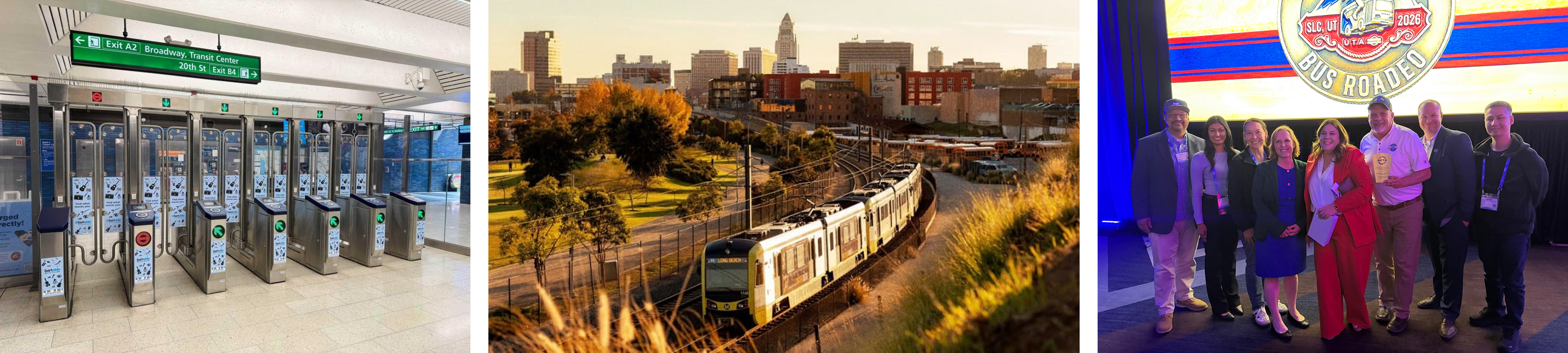
BART tests fare gate advertisements at nine stations to explore new revenue opportunity
BART is testing a new look on fare gates at nine stations as part of an ongoing effort to explore new and creative revenue opportunities as the agency faces a structural deficit starting in Fiscal Year 2027.
The fare gate advertising pilot will see fare gates at nine stations wrapped with advertising on their clear plexiglass doors and metal consoles to understand how the wrap material will perform in real-world conditions. The wraps have already undergone testing at BART’s fare gate lab to assess the material’s impact on the surface of the gates.
This pilot follows the testing of train car wrapping earlier this year, when BART Marketing covered a train car in cheerful BARTy mascots. These pilots will provide BART with a potential new revenue source as BART continues to implement significant cost-cutting measures that have reduced expenses by hundreds of millions of dollars.
The fare gate advertising pilot is rolling out at nine stations this week: 19th St Oakland, Downtown Berkeley, Dublin/Pleasanton, Concord, Fremont, 16th St Mission, and Daly City stations. Additional wraps will be installed at SFO and OAK stations ahead of the FIFA World Cup, starting June 13. Wraps at Downtown Berkeley will be removed after a month, while others will be left on for varied amounts of time.
"Fare gate wraps give us a new advertising canvas to work with, and we're excited to see how this pilot performs and potentially expand it throughout the system,” said BART Director of Marketing and Research David Martindale.
The wraps are designed to allow clear sightlines through the fare gates so BART Police and staff can still see across the fare gate line. BART Marketing also worked closely with BART Police and other internal stakeholders during the planning process to make sure the placement and materials met their standards.
This will be the first time BART has wrapped fare gates with advertising. In 2025, BART completed installation of new fare gates at all 50 stations, replacing the 50-plus-year-old system's original gates.
Early indications suggest that due to reduced fare evasion the new fare gates are responsible for BART revenue growing by about $10 million annually. Additionally, crime on BART plummeted 41% in 2025 compared to the previous year, despite the fare gate project being completed in August of that year and a steady increase in ridership. There was also a 961-hour reduction in corrective maintenance hours related to unwanted behavior in the 6 months post-installation.
AC Transit: California's Auditor Concludes East Bay Transit Agencies are Stronger than Critics Claimed
The year-long audit found transit’s greatest threat is the lack of sustainable long-term funding
The Alameda-Contra Costa Transit District (AC Transit) announces that the long-awaited state audit examining six East Bay transit agencies and the MTC, titled 2025-120 East Bay Transit Agencies, is now complete. Its findings come to a clear and unmistakable conclusion: AC Transit and five other East Bay transit agencies are already working together effectively across the region.
The State Auditor further concluded that while collaboration among transit agencies is functioning, the Bay Area’s public transportation systems face mounting structural fiscal pressures that threaten future service levels if sustainable funding solutions are not secured.
Commissioned by the Joint Legislative Audit Committee after a formal April 2025 request from State Senator Aisha Wahab, the audit was launched in response to concerns that East Bay transit systems were too fragmented, duplicated some services, created challenges for riders transferring between agencies, and faced long-term financial instability.
As part of the review, California State Auditor Grant Parks examined how well AC Transit, County Connection, Wheels, Tri Delta Transit, Union City Transit, and WestCAT work together, the financial pressures they face, and whether consolidating transit agencies would improve efficiency or reduce costs. The findings make one point clear: East Bay transit agencies are already coordinating in meaningful ways. The larger challenge is not a lack of collaboration, but the need for long-term, sustainable funding to protect future service.
Among the audit’s most significant findings:
Transit coordination across the East Bay is already strong.
Auditors took 12 real-world commute trips that everyday riders could reasonably make across East Bay service areas, covering about 25 percent of routes that cross agency boundaries. Their conclusion is that riders did not face significant barriers or major problems transferring between agencies.
MTC regional integration initiatives continue to lag behind schedule.
Although MTC has launched multiple initiatives intended to improve the rider experience across the Bay Area, auditors found that none of the nine reviewed initiatives were completed within their preliminary timelines. The finding raises concerns about the pace of regional transit modernization efforts.
Five of the six transit agencies face serious fiscal risks.
Apart from Tri Delta Transit, the selected East Bay transit agencies have adequate financial reserves in the short term. However, all but Union City Transit are at risk of depleting those reserves without new funding – some as soon as fiscal year 2026–27. As a result, agencies may be forced to reduce service levels, further impacting mobility, economic access, and regional connectivity.
Zero emission bus mandates present major financial hurdles.
Transit agencies reported significant concerns about the cost of purchasing and deploying zero emission buses required under California mandates. The report identifies the transition as a growing operational and fiscal challenge for public transit providers.
Transit agency consolidation is unlikely to solve financial problems.
Auditors examined whether combining agencies could improve financial sustainability and found that consolidation alone would not resolve structural deficits. Combined agencies would still face negative unrestricted net positions and long-term financial pressures.
Legal and labor-related barriers could complicate consolidation efforts.
The report notes that federal protections involving private contractors, along with differing labor agreements, would create substantial consolidation challenges. Additionally, standardizing wages and benefits across merged agencies could significantly increase costs because AC Transit currently maintains substantially higher labor costs than neighboring operators.
The audit presents a balanced view of how East Bay transit agencies are working together effectively for riders, but the region’s transit network remains financially vulnerable.
The report also makes clear that consolidation alone will not solve the problem. Long-term sustainability will depend on stable funding, careful management of rising operating costs, and the ability to meet ambitious state climate goals while navigating real fiscal constraints.
Caltrain Adopts Fiscal Year 2027 Operating Budget and All Independent Efficiency Report Recommendations
Caltrain’s Board of Directors approved its operating budget for Fiscal Year (FY) 2027 at the rail agency’s monthly board meeting, as well as all recommendations for early action strategies recommended by the SB 63 Financial Efficiency Review Independent Oversight Committee’s final Phase 1 report. This ensures that Caltrain service will continue its regular operation in the near term, but long-term financial challenges remain for the rail agency absent a new revenue source.
The FY27 operating budget is nearly $270 million, with funds coming from multiple sources, including fares, GoPass, Measure RR, parking and rental income, State Transit Assistance, and most notably, a one-time loan from the state through the Metropolitan Transportation Commission (MTC) that is intended to help address transit agency operations shortfalls in the Bay Area. With a balanced budget, Caltrain is able to continue its popular electric service, running trains every 15 minutes at most stations during peak hours and half hourly service at all other times, including weekends.
Caltrain managed to adopt a balanced budget by limiting cost increases across its operations, reducing professional services, stronger than anticipated fare revenue, and the one-time state loan. The agency continues to break ridership records, shattering previous records in March of this year, and again in April, and was named the fastest growing transit agency in the United States in 2025.
The Oversight Committee’s Efficiency Report recognized Caltrain’s $76 million in savings due to recent cost-saving measures. Since 2020, Caltrain has achieved over $76 million in cost savings, approximately 7% of the agency’s operating budget over the last five years. Caltrain’s cost savings were measured by MTC as required by Senate Bill (SB) 63, the Connect Bay Area act. The MTC report, issued earlier this month, showed that Caltrain’s cost savings were achieved primarily through workforce controls, service optimization and operating efficiencies.
Ongoing cost-reduction measures include a targeted hiring freeze saving $17 million, 30-minute service reducing the need for special trains, improved operator crew efficiency and reducing overtime saving $37 million, and the integration of the maintenance of new infrastructure into existing operating contracts saving approximately $2.1 million. Other measures include reducing professional services, temporarily deferring service increases, and efforts to reduce fuel and electricity costs.
Since Caltrain began its electrified service, these cost-saving measures have slowed the growth of operating costs, offsetting some of the inflationary pressures that many transit agencies continue to suffer from. Caltrain has also been actively pursuing additional avenues to monetize assets through a non-fare revenue strategy.
The Efficiency report highlighted Caltrain efforts and opportunities to grow parking revenue, leasing fiber and communications assets, pursuing an energy storage project to further optimize power use, and finding new customers for Clipper BayPass and GoPass, studying ways to activate and enhance retail at stations, in addition to monetizing Caltrain’s real estate holdings. Today the Caltrain board voted to approve and move forward with each of the “early action strategy” recommendations of the independent financial review committee.
“Ensuring we are responsible stewards of taxpayer money is vitally important to any public agency, regardless of the economic climate,” said Michelle Bouchard, Executive Director of Caltrain. “We are hard at work finding ways to be more efficient than ever before, while still providing a safe, world class service for the people who rely on us.”
Despite the important steps Caltrain is taking to control costs, generate revenue and grow ridership, Caltrain still faces an average $75 million deficit that would start in FY28. Absent a new, reliable funding source—through a regional measure or other external support—Caltrain will be forced to make significant service and staffing cuts, with potentially long-lasting consequences for the tens of thousands of people and businesses that depend on—and have begun to benefit from—the newly electrified system. Daily, Caltrain carries as many people as three lanes of Highway 101, avoiding 36,000 additional daily car trips, 828,000 miles of driving and an additional 220 metric tons of CO₂ each day.
FY26 begins on July 1, 2026 and ends on June 30, 2027.
LA METRO Launches Sworn Officer Recruitment for its Department of Public Safety
The Los Angeles County Metropolitan Transportation Authority (Metro) announced that its recruitment of law enforcement officers is off to a strong start with 950 applications received in the first 24 hours. The agency has entered the next phase of building its department of public safety and began recruiting for qualified law enforcement officers to serve among the department’s first sworn personnel. This foundational group of officers will play a critical role in shaping the department’s culture, policies, and community-focused approach from the ground up.
To support the recruitment effort, last week Metro launched a dedicated website, JoinMetroDPS.com, where prospective candidates can learn more about the department’s mission, hiring process, training model, and community-centered policing philosophy. The site includes application materials, minimum qualifications and details about the competitive pay and robust benefit package being offered.
“Metro’s ongoing efforts to enhance safety, build trust, and create a welcoming environment for all riders is evidenced by this important milestone,” said Fernado Dutra, Metro Board Chair.
“We are excited to mark this important milestone as we begin this critical next phase of building out Metro’s own Department of Public Safety. said Metro CEO Stephanie Wiggins. “We have built a strong foundation that reflects our deep commitment to accountability, training, and community-centered policing to lead our training program. Metro is leading the nation in creating a new approach to public safety for transit as it builds its Department of Public Safety (DPS) from the ground up.”
The DPS is led by seasoned law enforcement professionals with experience at the local and federal levels and operates as part of Metro’s broader care-based public safety approach. Unlike traditional models that rely primarily on law enforcement, Metro integrates ambassadors, homeless outreach teams, crisis and community intervention teams to assist customers and respond to quality-of-life issues. By matching each situation with the most appropriate responder, Metro is creating a more holistic public safety model that promotes safety, dignity, and support for riders while enabling law enforcement officers to focus on criminal activity and urgent safety concerns.
As a result, Metro has made significant progress in improving safety across its bus and rail system. Violent crime declined for the second consecutive year in 2025, reaching its lowest level since 2021, while customer satisfaction with safety measures reached record highs. The trend continued in March 2026, the most recent month for which crime data is available, with a 13.6% decrease in overall crime compared to March 2025.
In addition to their law enforcement training, all officers will receive specialized training tailored to the transit environment, including awareness issues that are unique to transit, trauma-informed response, de-escalation, and customer service.
“This is a rare opportunity in law enforcement,” said Metro Chief of Police and Emergency Management William Scott. “Joining this department means more than taking a job, it means helping to build a culture that protects the community from day one. We are looking for individuals who are committed to service, who value relationships, and who want a voice in creating the kind of department they’ve always wanted to join.”
On June 28, 2024, the Metro Board of Directors unanimously approved the establishment of an in-house public safety department to ensure increased visibility, accountability, and consistent service delivery. By the end of 2029, Metro’s Department of Public Safety will complete the deployment of its own hired and specially trained law enforcement officers in the field, alongside ambassadors, homeless outreach, and crisis response teams utilizing a zone-based deployment model. Each zone will have at least one crisis co-response team assigned to respond to calls and do proactive engagement on board trains, buses, and at Metro transit stations.
LA METRO Offers Stress Free, Comfortable Travel for All with Calming Rooms, Accessibility Tools, Heat Mitigation
Metro is ensuring accessibility and inclusion for all customers going to the matches during FIFA World Cup 2026™ by enhancing the experience with calming rooms, improved wayfinding for the visually impaired and resources to beat the heat.
“People from around the world are visiting Los Angeles during the World Cup and as the official transportation provider for the Los Angeles World Cup 2026 Host City, Metro is helping make the trip as stress free and comfortable as possible,” said Fernando Dutra, Metro Board Chair. “We are not only helping riders get to the matches but also providing support services to make their transit experience even better such as a spot to grab a cool drink of water or a place away from the crowds.”
Support for Neurodiverse Customers
On World Cup match days and during the Fan Zone at Union Station from June 25-28, there were inflatable sensory rooms at key transfer stations, including Union Station, 7th Street/Metro Center Station and LAX/Metro Transit Center Station. These temporary, on-site spaces are designed by Kulture City, a leading non-profit organization dedicated to sensory accessibility. These spaces function as a quiet, calming environment for individuals who may become overstimulated by crowds, lighting or noise. For people affected by sensory overload from unfamiliar places, these rooms can provide a respite from travel.
The inflatable rooms feature comfortable seating such as bean bags or mats, an enclosed environment that helps minimize noise and external stimulation, reduced or adjustable lighting, sensory tools such as fidget and tactile items and noise-reducing headphones. Entry is also accessible for individuals using mobility devices.
Expanded Accessibility Tools
Metro also expanded accessibility through a pilot partnership with Waymap, a navigation platform that provides accurate indoor and outdoor wayfinding for blind and visually impaired customers. The technology is available at six rail stations: LAX/Metro Transit Center, Union Station, 7th Street/Metro Center, Civic Center, Wilshire/Vermont, and Vermont/Santa Monica. By June 26, the app was available at six additional stations: Expo/Crenshaw, Little Tokyo/Arts District, Historic Broadway, Grand Avenue Arts/Bunker Hill, Pershing Square and Vermont/Beverly.
Waymap provides QR codes and direct download links to the Apple App Store and Google Play Store. Unlike traditional navigation tools that rely on GPS, Waymap uses advanced motion science and digital mapping technology to deliver precise guidance through complex transit environments. If the pilot is successful, and funding is available, Metro will add data from more stations to the app.
Beating the Heat
Metro is also providing hydration stations so that on the hottest days, riders can cool off and hydrate while traveling to and from the matches at LA Stadium. Each hydration station provides water, chilled and tested, for use in reusable water bottles, misting fans, shade canopies, sunscreen and cooling towels. For those without a reusable water bottle, paper cups are available for a cool drink.
The hydration stations are located throughout the system at park and ride locations and 20 stations providing enhanced bus service to the games. Stations include; Downtown Inglewood, Downtown Santa Monica, Fairfax, Leimert Park, Little Tokyo, Mariachi Plaza, Memorial Park, Reseda, Wilshire/Western, LAX/MTC Transit Center, North Hollywood, Union Station, Crenshaw (C Line), El Camino College, Harbor Gateway Transit Center, Hawthorn/Lennox and Pierce College.
Riders can find the Metro hydration stations to refill their reusable water bottles by using the WeTap app interactive map. Additional cooling centers can be located at Cool Spots LA interactive map for cooling centers and hydration stations across LA City and County to cool down during extreme heat days.
Extreme heat and large crowds can make travel more challenging. Whether heading to World Cup matches, a concert, festival or community event, Metro encourages everyone to be prepared for extreme heat days.
“Transit systems are built for people, and they should provide the resources everyone needs to travel safely, comfortably and confidently,” said Metro CEO Stephanie Wiggins. “From navigation tools and calming spaces to hydration stations and other customer amenities, we’re making Metro more accessible, inclusive and welcoming as part of our efforts to serve both Angelenos and visitors during the World Cup.”
The improved accessibility amenities are a part of a larger effort at Metro to make the system better for all its customers. This includes a total of 64 safe and clean Throne restrooms that customers can unlock using a mobile phone, as well as the recent introduction of contactless payments, which allows customers to pay their fare at fare gates using their credit or debit card, and the launch of the Official LA Metro Mobile app, which customers can use to plan their transit route, and receive alerts about any detours or disruptions.
More information and a handy guidebook to help plan and travel safely can be found at Metro.net.
Monterey-Salinas Transit Receives American Public Transportation Association's 2026 Safe, Effective, Clean Transit Excellence Gold Award
Monterey-Salinas Transit (MST) has been selected as the 2026 Gold Winner of the newly established American Public Transportation Association (APTA) Safe, Effective, Clean Transit Excellence Award, which recognizes public transportation providers that deliver dependable, welcoming, and responsive service.
Team MST proudly attended APTA’s Annual Mobility Conference to receive the award and celebrate the agency’s achievement.
MST was selected based on APTA’s evaluation criteria: effectiveness, benefit level, innovation, and transferability, recognizing agencies that demonstrate measurable results, meaningful benefits, creative problem-solving, and practices that can be replicated across the transit industry.
“We’re honored to receive this recognition from APTA,” said MST General Manager/CEO, Carl Sedoryk. “This award reflects our team’s focus on delivering safe, clean, and reliable service every day, and it reinforces our commitment to improving the experience for the passengers and communities we serve.”
San Francisco Bay Ferry Sets Another Ridership Record in May
San Francisco Bay Ferry has announced it beat its all-time May ridership record, setting a passenger count record for the third straight month and beating pre-pandemic ridership for the sixth consecutive month.
SF Bay Ferry carried 301,270 passengers in May, up 8% from 2025. This mark is also higher than 2019 ridership. The agency first beat its 2019 ridership in May 2025. High weekend ridership continues to fuel records: SF Bay Ferry carried 15,004 riders on an average two-day weekend this May, up 56% from the same month pre-pandemic.
Year-over-year ferry ridership has now grown for 59 consecutive months. The Vallejo route had the highest passenger count systemwide for the 22nd consecutive month, with the Oakland route coming in second.
In 2021, the agency relaunched ferry service built around providing robust commute and off-peak service at lower fares. SF Bay Ferry has also leaned into new services including the Oakland Alameda Water Shuttle connecting Jack London Square to Alameda Landing and popular service to Chase Center for Valkyries and Warriors games.
Building off the popularity of the past winter’s Tides and Tunes campaign, the agency re-launched the live music series. On May 29, Feeling Groovy, a local Simon and Garfunkel tribute band, performed for passengers commuting home to Richmond or into Downtown San Francisco. Media clips and photos from the event can be found here. June will feature two Tides and Tunes evenings, on June 12 and 26, and the series will continue on the final Friday each month until October. All performances will be on the Richmond route from 3:40-6:35 p.m. Performances are free with passenger fares.