OCTA’s Summer Trolleys, Funded by Measure M, Keep Orange County Moving; BART: Join a group BART speedrun on September 6 to celebrate BART’s birthday; San Diego MTS Receives Prestigious Outstanding Public Transportation System Award; Caltrain named one of North America’s top transit agencies; Monterey-Salinas Transit (MST) and Hartnell College Launch Tap2Ride Pilot for Students This Fall; Metro’s Integrated Public Safety Model Drives 57% Reduction in Homelessness on Transit System Since 2024.
By Transit California Staff
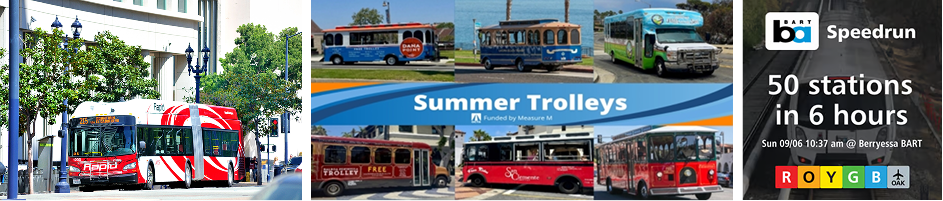
OCTA: OCTA’s Summer Trolleys, Funded by Measure M, Keep Orange County Moving
Seasonal trolley services to the beach and other parts of Orange County connect riders to six coastal cities in Orange County through the summer months and beyond
Free summer trolley services funded by the Orange County Transportation Authority continue to provide convenient transportation to Orange County’s coastal communities, offering residents and visitors an easy way to reach beaches, restaurants, shopping destinations and local attractions while helping reduce traffic congestion during the busy summer season.
Funded through Measure M, Orange County’s voter-approved half-cent sales tax for transportation improvements, the seasonal trolley services are operated by six Orange County cities. Service continues through Labor Day, with select routes extending into late September.
The trolley program is part of OCTA’s Community-Based Transit Circulator Program, which supports locally operated services tailored to the transportation needs of individual communities.
During the most recent six-month reporting period, presented to the OCTA Board of Directors this week, the services carried nearly 276,000 passengers, reflecting the continued popularity of these transportation options. That ridership includes 14 shuttles that operated throughout Orange County, including in Anaheim, Huntington Beach, Irvine, La Habra, Los Alamitos and Mission Viejo.
In calendar year 2025, the shuttles traveled approximately 650,000 miles and helped more than 840,000 people reach their destinations more efficiently.
“Measure M continues to deliver meaningful transportation improvements that benefit Orange County residents and visitors,” said OCTA Chair Jamey M. Federico. “These free trolley services provide convenient and fun access to some of Orange County’s most popular destinations while helping reduce congestion, easing parking demand and offering an enjoyable alternative to driving.”
Each trolley connects riders with OC Bus service, and several routes also provide direct connections to Metrolink stations, expanding regional transit options throughout Orange County.
The summer trolley program is one of several local transit services funded through Measure M. Measure M is Orange County’s voter-approved half-cent sales tax that funds a balanced transportation system through freeway, street, transit and environmental improvements. Delivered by OCTA with independent taxpayer oversight, Measure M enhances safety, expands travel options and keeps Orange County moving.
BART: Join a group BART speedrun on September 6 to celebrate BART’s birthday
The big BART Transit Month speedrun is back!
On Sunday, September 6, speedrunners will race to all 50 BART stations to celebrate BART’s 54th birthday and California Speedrun Day, hosted in partnership with the California High School Transit Alliance and the New Urbanism Initiative. Seventy people turned out for last year’s speedrun – the largest group to speedrun any transit agency (that organizers are aware of) – and they’re hoping to outdo that number this year.
The day begins at Berryessa/North San Jose Station, where participants will catch a 10:37am Orange Line train. From there, speedrunning pros will lead the group through every BART station as quickly as possible, with BART representatives joining along the way. During the trip, participants can test their BART knowledge with trivia about different stretches of track and compete for transit-themed prizes.
The run should take about six hours. Join for the full ride or hop on and off along the way. No prior speedrunning experience required!
If the group misses a transfer, they’ll let folks know at the top of the schedule document and on social media (follow CalHSTA on Instagram and Bluesky).
What’s speedrunning?
The challenge is to visit every BART station in as little time as possible. That means 50 stations and 131 miles of track while making connections, timing transfers, and navigating the system as efficiently as possible.
It’s a fast-paced way to see the Bay Area, made all the more fun by traveling with a group of transit enthusiasts. BART is a massive system that covers a huge swath of the region; when you travel all 131 miles of BART trackway in six hours, you get an exhilarating sense of the patchwork of places, climates, and people that make up the region.
“I love seeing everyone show up to speedrun BART, people of all ages, backgrounds, and locations in the Bay Area,” said Harvy Chang, organizer and BART speedrunning pro. “Fun community events like large speedruns can motivate the public to ride transit and help us move toward a more sustainable future with fewer cars and more environmentally friendly transportation.”
Speedrunning has become a popular pastime among transit enthusiasts around the world, and BART has a dedicated webpage for records. Our site inspired transit fans to start transitruns.org, a centralized website that compiles leaderboards worldwide.
BART has been a destination for speedrunners for over a decade. More than 25 speedrun attempts have been made on BART since 2012 (that BART knows about). We've also spotlighted some of our most prolific speedrunners in a podcast. The current BART speedrun record is 5 hours, 9 minutes, and 35 seconds, set in October 2024. The current Guinness World Record is 5 hours, 47 minutes, and 42 seconds, set in March 2024.
Details
When: Sunday, September 14, 10:37 am train departs (arrive early so you don’t miss it)
Where: Meet at Berryessa/North San Jose Station (on the lower level past the fare gates). Full schedule here.
RSVP here. It’s not required, but it will help with a headcount.
BART fare: Make sure you have $12.15 on your Clipper card, not including your BART ride to Berryessa and your ride home, or pay for your trip with Tap and Ride. Bring a water bottle and use the restroom beforehand.
CalHSTA social media: Instagram (@calhstatransit) and Bluesky (@calhstatransit.org)
Celebrate Transit Month
The group speedrun is part of Transit Month, when communities across the Bay Area celebrate public transportation with events and activities throughout the region. Learn more here.
San Diego MTS Receives Prestigious Outstanding Public Transportation System Award
The American Public Transportation Association (APTA) recognized MTS for its achievements in service operation, passenger safety, customer service, financial management and more
Agency leadership played a vital role in high-performing operational excellence
The San Diego Metropolitan Transit System (MTS) received the transportation industry’s most prestigious annual award, the Outstanding Public Transportation System. Presented through the American Public Transportation Association’s (APTA) annual awards program, the award recognizes transit systems that demonstrate exceptional leadership, serve as outstanding models of excellence, and advance the future of public transportation through innovation and achievement.
“This award reflects the extraordinary progress MTS has made in delivering value to the communities we serve,” said Stephen Whitburn, MTS Board Chair and San Diego City Councilmember. “From strengthening public safety and security to improving accessibility, embracing innovation, and responding to customer needs, MTS has demonstrated a commitment to continuous improvement across every aspect of the organization. I am proud of what our team and the Board of Directors has accomplished and excited about the strong foundation we are building for the future of transit in San Diego.”
“Receiving APTA’s Outstanding Public Transportation System Award is an incredible honor and a testament to the dedication of our employees, the support of our Board of Directors, and the trust our riders place in us every day,” said Sharon Cooney, Chief Executive Officer of MTS. “Over the past several years, MTS has remained focused on delivering safe, reliable, and innovative transit services. This recognition reflects the hard work of our entire organization.”
During the past three years, MTS established itself as one of the highest-performing large transit agencies in the United States. While many agencies continued to face challenges associated with workforce shortages, financial uncertainty, and slower-than-expected ridership recovery, MTS consistently exceeded expectations through a balanced focus on safety, service quality, innovation, and fiscal stewardship.
In Fiscal Year 2025 alone, the agency provided more than 81 million passenger trips and recovered 95.2 percent of its pre-pandemic ridership, making it one of only two Top 40 transit agencies nationwide to surpass the 95 percent recovery threshold. Other notable accomplishments included:
Earned a perfect score on the Federal Transit Administration’s 2025 Triennial Review, with no deficiencies identified.
One of only two U.S. transit agencies to receive the Transportation Security Administration's (TSA) Gold Standard Award for security and resilience.
Achieved the nation’s lowest light rail operating cost among large transit agencies at $212 per service hour.
Delivered a $3.58 cost per passenger, 40% better than the next-ranked agency, while ranking second nationally in ridership productivity.
Partnered with 30 agencies countywide to connect people experiencing homelessness with housing, healthcare, and support services.
“Congratulations to the 2026 APTA Award winners and Hall of Fame inductees,” said Leanne Redden, APTA Board Chair and Executive Director of the Regional Transportation Authority. “Their leadership reflects the very best of our industry, and it shows in their relentless commitment to connecting communities, advancing innovation, and improving the lives of the riders they serve every day. I'm proud to celebrate their achievements alongside the entire APTA community.”
“The achievements and legacies of our awardees represent the passion and expertise driving public transportation forward. Their work strengthens the communities they serve and sets a standard for excellence across our industry. On behalf of APTA, congratulations to the 2026 winners and Hall of Fame inductees,” said APTA President and CEO Paul P. Skoutelas.
This recognition showcases MTS as a transit agency that delivers strong results today while building a resilient foundation for the future.
The award will be presented to MTS at the APTA 2026 Honors Ceremony during the 2026 TRANSform Conference & EXPO in Chicago this October.
Caltrain named one of North America’s top transit agencies
Caltrain will receive the Outstanding Public Transportation System Achievement award this fall in Chicago, according to the American Public Transportation Association (APTA). The award honors transit agencies that demonstrate superior achievement in efficiency and effectiveness and is the most prestigious award an American public transit system can receive.
Caltrain entered the competition for the award this year as a strong contender with many achievements, including:
“Caltrain is honored to receive APTA’s nationwide recognition of excellence,” said Caltrain Executive Director Michelle Bouchard. “Our newly electrified railroad is offering the best service this rail corridor has seen in 162 years, and we’re seeing the result every day as more and more people choose to ride the Peninsula the way it was meant to be traveled.”
“After completing our once-in-a-generation electrification project, it’s wonderful to receive such recognition from our peers in the transit industry,” said Caltrain board Chair Rico E. Medina. “Caltrain will continue to improve and innovate as it serves this region and the millions of people who rely on it.”
“Thanks to its reinvented electrified service, Caltrain is serving more people every day,” said Caltrain board vice-chair Pat Burt. “This national recognition is yet more recognition that our investment in this railroad has been a big success, and we will continue to serve the millions of people who rely on us to get them where they need to go, fast and on time.
This fall, representatives from Caltrain will attend the APTA TRANSform Conference in Chicago to accept the award.
Since the launch of electrified service, Caltrain has provided cleaner air for communities along the corridor and faster, more frequent service for riders throughout the San Francisco Peninsula with a state-of-the-art electric fleet featuring modern amenities such as free Wi-Fi, power outlets, baby-changing tables in the bathroom, and much more.
Monterey-Salinas Transit (MST) and Hartnell College Launch Tap2Ride Pilot for Students This Fall
Beginning this fall semester, Hartnell College students will be able to ride MST (still free!) more easily than ever through a new Tap2Ride pilot program that allows students to board by simply tapping a contactless bankcard on the fare reader.
The pilot streamlines the boarding process by eliminating the need for students to show their student ID to the driver. Instead, students can quickly and securely tap a contactless bankcard on a fare reader, creating a faster and more convenient experience for both riders and operators.
The technology behind the pilot is provided by Jawnt, a mobility technology company that helps transit agencies modernize fare payment systems and improve access to public transportation. The company works with transit providers across North America to simplify fare collection and enhance the customer experience.
The Tap2Ride pilot is part of an ongoing partnership between MST and Hartnell College to improve access to education, employment, and essential services through public transportation. The pilot is the next step in MST’s groundbreaking contactless payments system, which allows anyone with a major credit/debit card or contactless-enabled device to tap to pay and register to receive any discounts for which they may be eligible.
“Public transit plays a vital role in helping students reach campus, jobs, and other opportunities,” said Carl Sedoryk, MST General Manager/CEO. “By working with Hartnell College to implement this technology, we’re making it easier for students to access the transportation benefits available to them while improving the customer experience.”
Jawnt CEO, Jeff Stade, stated, “Connecting students to transit, while they’re in such an exploratory and transitional life phase, is a great way to win lifelong transit riders. Jawnt is excited to make it easier for students to build these habits.”
“Hartnell College is committed to removing barriers that can impact student success,” said Sandra Guzman, Hartnell College Vice President of Student Affairs. “This pilot makes it easier for our students to take advantage of transit services and focus on what matters most: their education.”
In addition to improving convenience, the Tap2Ride program is expected to reduce boarding times and create a more seamless transit experience by allowing students to validate their eligibility electronically.
The pilot will launch at the start of the Fall 2026 semester. MST and Hartnell College will monitor the program’s performance and gather feedback from students throughout the pilot period.
Metro’s Integrated Public Safety Model Drives 57% Reduction in Homelessness on Transit System Since 2024
Care-Based Approach, Connectivity to City, County Services Key to Meaningful Progress
Metro today announced a 57% decrease in the number of people experiencing homelessness on the transit system since 2024, the second consecutive year of significant progress. The 2026 point-in-time count found 31% fewer people experiencing homelessness in the transit system than the previous year. This year’s count estimates 395 to 517 unhoused individuals on Metro compared to 631 to 684 in 2025 and 1,041 to 1,092 in 2024. As the point-in-time count is not an exact census, it is reported as a range to account for any statistical margins of error.
The results underscore the effectiveness of Metro’s integrated public safety model, which combines compassionate, care-based services with coordinated law enforcement and security to improve safety, connect vulnerable individuals with housing and supportive services, and enhance the customer experience across the transit system.
“During and after the COVID-19 pandemic, many more unhoused people began to populate our Metro system,” said Metro Board Chair and Los Angeles Mayor Karen Bass. “Under the leadership of CEO Stephanie Wiggins and the Metro Board during my first term as Chair, we combined compassionate outreach with enhanced public safety strategies to get people housed with the services they need. These results prove that our approach is working and these efforts must continue.”
The latest point-in-time count builds on the momentum Metro has established through its innovative care-based approach to public safety. In January, Metro’s Department of Public Safety launched its Care-Based Services Division, bringing together Metro Ambassadors, the Homeless Outreach Management and Engagement (HOME) program, and Community Intervention Specialists under a single division within the Metro Public Safety Department.
“This continued decline reflects the dedication of Metro employees and our many partners who work every day to address homelessness with compassion, accountability and coordination,” said Metro CEO Stephanie Wiggins. “Creating the Care-Based Services Division reinforced our belief that public safety is strongest when care-based services and enforcement work together. These results show that our model is making a real difference—for people experiencing homelessness and for the tens of thousands of customers who rely on Metro every day.”
Metro’s success continues to be driven by close collaboration with the Los Angeles County Department of Homeless Services & Housing, the City and County of Los Angeles, and community-based organizations that provide outreach, interim housing, permanent housing placement, and other supportive services. These partnerships ensure individuals encountered on the transit system have meaningful opportunities to transition from transit to appropriate care and housing. In fiscal year 2026, Metro’s outreach teams connected 354 individuals to permanent housing.
The Greater Los Angeles Homeless Count led by the Los Angeles Homeless Services Authority (LAHSA) was conducted between January 20-22, with the Metro count taking place on January 20, 2026. 62 volunteers consisting of outreach workers, Metro employees and riders counted the rail and busway system in one evening. Metro used the same counting methodology as the county-wide effort, developed by LAHSA and aligned with U.S. Department of Housing and Urban Development (HUD) standards. The Metro-specific results, which focused on stations, rights-of-way, and parking lots, were not included in LAHSA’s published regional total but provide an essential look at homelessness on the transit system.