With SB 125 and SB 840, California promised critical multi-year investments in transit, but recent regulation amendments threaten to upend those commitments.
By Arianna Smith
Managing Editor
Transit California
The Legislature returns from summer recess on August 3 for a marathon month of committee hearings, budget negotiations, and floor sessions to beat the August 31 deadline to send bills to the Governor’s Desk.
Although the Legislature passed the main Budget Bill and several trailer bills on June 15, questions about transit funding remain unanswered. Governor Newsom signed the primary bill and several trailer bills into law on June 29, declaring at the time, “We’re leaving California stronger than we found it — and leaving the next generation a state that’s fiscally sound, economically dominant, and ready for whatever comes next.”
But transit, housing, and air quality programs that rely on the Greenhouse Gas Reduction Fund (GGRF) may not be ready for whatever comes next if the Cap-and-Invest fund restructuring moves forward as proposed by the Administration.
Fortunately, the Governor and Legislature have committed to revisiting GGRF expenditures upon their return from summer recess on August 3. Here’s where transit stands on the issue, and here’s how Association members can act now to save critical funds.
Cap-and-Invest proposal to restructure GGRF effectively cuts transit, housing, and climate funds
GGRF provides critical funding to programs that help the state meet its greenhouse gas emission reduction targets and improve local air quality with programs like the Affordable Housing and Sustainable Communities Program (AHSC), which funds affordable transit-oriented housing; the Transit and Intercity Rail Capital Program (TIRCP), which funds major transit projects and zero-emission vehicle deployments; the Low Carbon Transit Operations Program (LCTOP), which funds transit service and fare free and discounted transit passes; and AB 617, which funds community-led air quality initiatives in California’s disadvantaged communities. In 2025, SB 840 recast Cap-and-Trade as Cap-and-Invest and established that the above programs would be funded under GGRF’s Tier 3 category, which only receives funds after Tier 1 and Tier 2 are fully funded.
In April 2026, the California Air Resources Board (CARB) released Proposed Amendments to the Regulation for the California Cap on Greenhouse Gas Emissions and Market-Based Compliance Mechanisms, which proposed to increase allowances, including to the state’s electricity and gas utility companies, by nearly $2 billion annually. The proposal would reduce GGRF revenue by a commensurate amount annually and would guarantee that total annual GGRF funding would fall short of $4.2 billion by more than $2 billion, zeroing out the hard-fought annual Tier 3 funding for the AHSC, TIRCP, LCTOP, and AB 617 communities. In response to the proposed amendments, the Association established and led a broad coalition of 120 organizations to fight to protect GGRF-funded programs by appealing to CARB, the Administration, and the Legislature.
Ultimately, despite the broad opposition demonstrated before and during the hearing from legislators and Association coalition partners, CARB voted 10-3 to adopt the proposed amendments. For a complete explanation of the unusual CARB amendments and the Board vote, see Transit California’s May 2026 feature.
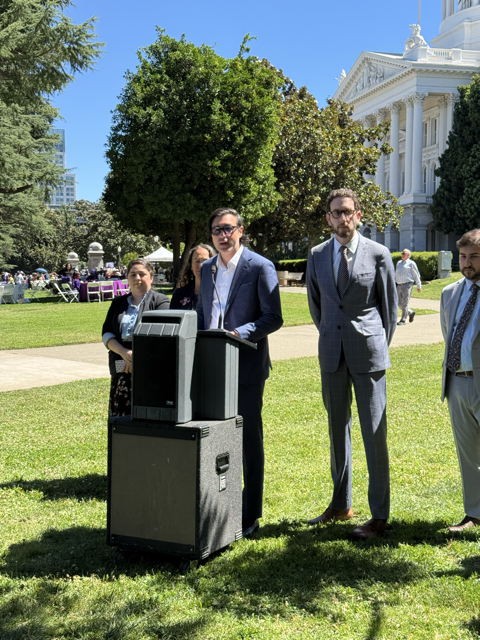
“California's Greenhouse Gas Reduction Fund has long supported investments in affordable housing, public transit, and community clean air programs. But today, those investments are at risk,” said Michael Pimentel, Executive Director of the Association, of the action.
A pivot to saving remaining SB 125 funds
CARB’s action has set the stage for GGRF revenues being reduced significantly to the point of eliminating all funds for Tier 3 programs, beginning this fiscal year, by invalidating the 2025 funding agreement reached between the Administration and Legislature in SB 840. One-time funding commitments originally made in 2022 through SB 125 - Zero-Emission Transit Capital Program (ZETCP) and annual funding commitments for "Tier 3" programs, including AHSC, TIRCP, LCTOP, and AB 617 - are now at risk of receiving little or no funding.
Following CARB’s vote, the Association and most of the original coalition partners, along with the addition of several disability community organizations, are moving forward to ensure that these remaining critical program funds are protected. A full list of the coalition partners can be found in a letter urging Governor Newsom, Senate President pro Tempore Monique Limón, and Assembly Speaker Robert Rivas to honor their ongoing funding commitments to the Tier 3 programs established by SB 840.
“[R]educing this funding will jeopardize the state’s ability to meet its 2030 greenhouse gas reduction targets,” declared the coalition partners in the letter, which staked out the position for maintaining the ongoing appropriation promised in 2022 legislation of $800 million for AHSC, $400 million for TIRCP, $200 million for LCTOP, and $250 million for AB 617.
The Association has launched a new task force to steer final engagement on GGRF funding, particularly in regard to engagement with the Assembly and the Governor’s Administration. Association leadership is also working closely in concert with its Senate champions who stepped up in May to advocate against the CARB vote and in favor of Tier 3 programs. Finally, the Association is undertaking a new public affairs campaign focused on advancing Tier 3 to ensure that this extensive groundwork is supported by additional public pressure.
What Association members and partners can do NOW
The Association has built and activated a broad coalition of housing, transportation, local government, environmental, labor, and disability rights organizations, focused on urging state leaders to protect these critical investments.
The topline, urgent message to the Governor’s Administration and legislators is that GGRF investments are not abstract budget line items; they fund real projects and services that reduce pollution, improve mobility, lower household transportation costs, support affordable housing production, and protect public health in communities that need these investments most.
Association member organizations can show this strength, commitment, and value of transit to legislators, as they return to finalize budget negotiations.
You can take action now! Here are some important ways your organization can contribute to the effort to secure these previously committed funds:
For more information and ways to take action, see the Association’s July Action Alert, watch for weekly Monday updates in the Executive Director Report and periodic email and social media updates throughout August, and be ready to amplify the upcoming public affairs campaign.