With a new division, office reorganizations, and added executive-level positions, Caltrans is elevating mass transportation to reflect updated Administration priorities.
By Arianna Smith
Managing Editor
Transit California
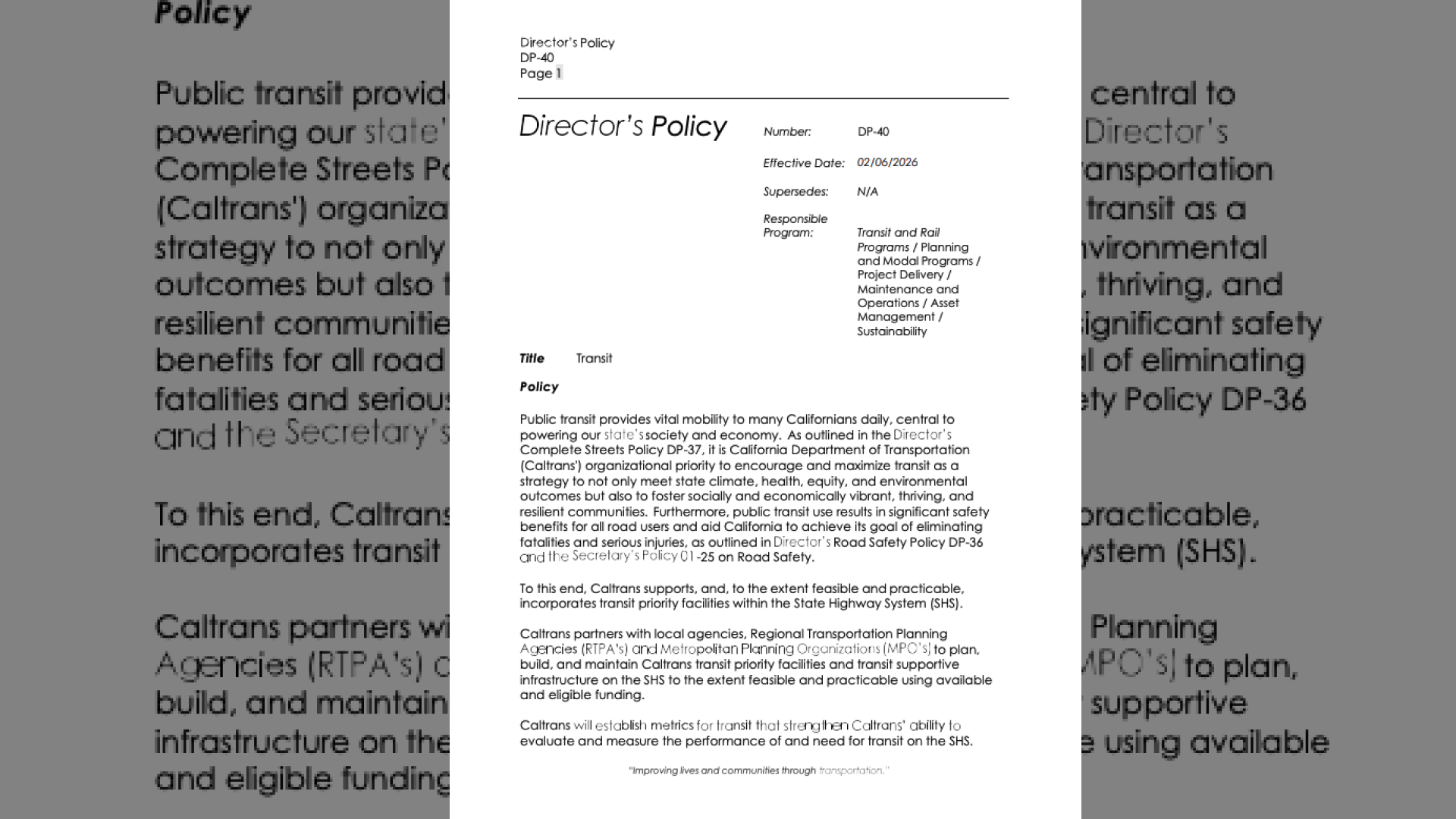
In February 2026, the California Department of Transportation (Caltrans) unveiled Director Dina El-Tawansy’s much-anticipated Transit Policy. The policy aligns with the “Core Four” priorities of the California State Transportation Agency (CalSTA) of safety, equity, climate action, and economic prosperity, and it provides a high-level outline of Caltrans’ commitment to connect and improve transit options in California.
“The Director's Transit Policy is focused on three key pillars: Planning, Projects, and Data, committing Caltrans to utilizing design flexibility and context-sensitive solutions to enhance transit networks for travelers of all ages and abilities,” wrote El-Tawansy in a 2025 letter announcing the draft policy’s comment period.
Now in its early implementation stage, the policy outlines numerous organizational changes that will affect when, where, and how transit agencies interact with Caltrans in seeking state guidance and funding.
An implementation fact sheet indicates that the policy, “will provide Caltrans direction for incorporating public transit into the state highway system and enhancing bicycle, pedestrian, and transit connectivity to local and regional networks.” According to the policy, the ultimate intended result is, “to improve transit access on the State Highway System.”
The policy originates from Senator Scott Wiener’s 2024 legislation SB 960, a measure supported by the Association. In describing the need for the law, Senator Wiener argued, “California has one of the highest rates of death and serious injuries from vehicle collisions in the country. Traffic violence disproportionately impacts pedestrians, bicyclists, children, seniors, and people of color. This bill will make state-owned highways safer and more convenient for all users, including pedestrians, bicyclists, transit riders and drivers. . . . This bill is needed to reduce traffic violence, reduce congestion, reduce greenhouse gas emissions, improve transit, and ensure equitable access to mobility for all Californians.”
Ultimately, the policy is designed to prioritize long-term California transit needs. “To the fullest extent feasible and practicable, Caltrans will incorporate public transit features within the State Highway System and improve bicycle, pedestrian, and transit connectivity to local and regional networks,” wrote Director El-Tawansy in the policy.
To educate transit agencies on the upcoming changes, on April 7 the Association partnered with the California Association for Coordinated Transportation and Caltrans to host an explanatory webinar. Watch the recorded webinar here.
Here’s what you need to know.
Here’s what’s changing that matters most to transit agencies
The Transit Policy has created a new program, the Transit and Rail Programs. The new program will be overseen by the newly-created position, the currently vacant Deputy Director of Transit and Rail Programs, and that individual will report to Director El-Tawansy. Two existing divisions will be moved to the jurisdiction of this program from Planning and Modal Programs: The Division of Rail and the Division of Data and Digital Services/Cal-ITP. Caltrans Districts will interact with this division with regard to the District Transit Plan updates, which are due in 2028.
Of high interest to transit agencies, a new Division of Mass Transportation will be established to oversee three existing offices that will continue to carry out their current functions. The Office of Transit Planning coordinated the development of the Director’s Transit Policy; the office will also continue to maintain the statewide transit project database and provide leadership on major statewide transit planning policies. The Office of Transit Grants and Contracts includes compliance activities, procurement reporting systems, and zero emission transit initiatives.
The Office of Project Development, Management, and Delivery, which is responsible for managing the $11 billion in Transit Intercity and Rail Capital Programs (TIRCP) funding, will receive a new executive-level manager specifically to be accountable to TIRCP planning.
The Transit Policy is intended to provide major benefits to the public and California transit agencies. First, it is intended to strengthen collaboration and engagement with local, regional, federal, and private partners. It is also intended to guide Caltrans with its maintenance of a positive partnership with the Federal Administration. Finally, the program, division, and office reorganization is intended to ensure that Caltrans can provide fast, transparent, consistent decision making and guidance to transit agencies and transit districts alike.
“We have the benefit of working with more than 300 agencies across the state in the transit space, and it's just really important that we're engaging and collaborating at all levels,” said Marlon Flournoy, Chief of Caltrans’ Division of Transportation Planning of the update.
Transit Policy informed by long-term, wide-ranging transit stakeholder work
Caltrans representatives considered a variety of legislation, plans, and stakeholder work during the development of the Director’s Transit Policy.
Numerous previous plans were consulted in its development. The California Transportation Plan 2050, released in 2021, was a long-range policy plan that delineated recommendations to help guide the next 30 years of transportation decisions and investments to meet future transportation needs and reduce greenhouse gas emissions. The Caltrans 2024-2028 Strategic Plan informed organizational adaptations, as well as measurements of progress for Caltrans offices and divisions. In 2025, CalSTA released its final Climate Action Plan for Transportation infrastructure (CAPTI 2.0) to further prioritize the reduction of greenhouse gas emissions through transportation funding investments.
The Transit Policy also draws on previous Directors’ Policies to eliminate roadway injuries and fatalities (DP-36) and to provide comfortable, connected, complete streets (DP-37).
Additionally, Caltrans considered stakeholder commentary provided during Transit Transformation Task Force meetings held between 2023 and 2025, which were mandated by the transit funding budget bill, 2023’s SB 125. Association members made up nearly half of Task Force members and carefully coordinated messaging to help address long-term transit challenges for ridership recovery and declining revenues; the Task Force concluded with a final report in 2025 which held promise but fell short on providing much-needed specific policy and budget action recommendations.
Next Steps
Currently, Caltrans is in the process of implementing the Director’s Transit Policy. The intended result is to support faster and more efficient transit, built transit priority infrastructure and transit-supportive facilities on the State Highway System, increase transit planning, and develop more comprehensive data to support planning and project delivery.
Priority facilities include stops, signal priority, rate meter priority, bus-on-shoulder allowances, queue jumps for buses, and investments that improve speed and reliability.
In 2026, Caltrans will host focus groups and release its Transit Implementation Plan. Next year, District Transit plans will be due in Winter 2027, and in Summer 2028, Caltrans will provide its Transit Priority Design Guidance.
Ultimately, the Transit Policy is intended to reflect Caltrans’ stated vision to create conditions for Californians to thrive and stay connected.
“What do I see as our role at Caltrans?” asked Flournoy during a presentation on the Transit Policy. “If I were to sum it up in one word, I would say, ‘partner.’”