The state recently approved an emergency loan to financially-distressed Bay Area transit agencies, but the loan doesn’t solve long-term funding woes. A proposed regional sales tax measure could help - but only if it gets placed on the ballot and is approved by voters.
By Arianna Smith
Managing Editor
Transit California
Bay Area transit agencies continue to face financial deficits, and they are preparing for the possibility of implementing major service cuts and layoffs in coming fiscal years. The last of the post-pandemic state and federal emergency aid is expiring in June 2026, ridership remains stubbornly below pre-pandemic levels across many routes, and a newly approved state loan will only provide temporary relief for beleaguered operators.
But transit operators and riders alike have reason to hope that much-needed services can remain in place for the long-term: this November, voters may have the chance to approve a regional sales tax measure that could raise as much as $1 billion annually for the financially-distressed agencies.
Nothing is certain, however: the measure has yet to qualify for the ballot.
A dire fiscal situation for Bay Area transit agencies
Across the Bay Area, transit agencies are reckoning with previously unthinkable cuts to service if no long-term funding source becomes available.
“Bay Area Rapid Transit (BART) is facing a structural deficit of $350M to $400M annually because BART ridership is still down 50% compared to pre-pandemic levels. The proposal not only includes service cuts, station closures, and fare increases, but a 40% reduction in system support services, including potentially laying off 1,200 employees,” said Alicia Trost, BART Chief Communications Officer. “A combination of solutions will be needed, and each one comes with its own risks. The BART Board will soon adopt this deficit reduction framework as part of their budget development process.”
According to a February BART Board Workshop, BART could close up to 15 stations, reduce train service by 70%, and cut service back to 1970s levels.
The San Francisco Municipal Transportation Agency (SFMTA or Muni) warns of equally dramatic actions on its budget planning website: “Unfortunately, we are up against the largest budget deficit we have ever faced. The pandemic decimated the city's tax base by hollowing out downtown. Relief funding and other revenue sources have dried up. . . . This leaves the SFMTA with a budget deficit of $307 million beginning July 2026. That deficit is expected to grow to $434 million by July 2030. We will have to make dramatic changes to Muni service and programs if we are unable to fill these gaps.” SFMTA reported that it might have to cut up to 20 bus lines altogether and reduce service frequency on remaining lines.
Alameda-Contra Costa Transit District (AC Transit) and the Peninsula Corridor Joint Powers Board (Caltrain) could be forced to make similarly draconian cuts to their services.
BART, Muni, AC Transit, and Caltrain carry over 80% of transit riders in the Bay Area.
A loan to bridge the gap until agencies secure long-term funding
In a piece of positive news, Bay Area transit agencies recently secured some temporary funding relief.
As reported in Transit California in January 2026, the Newsom Administration, the Legislature, and transit partners inserted a general agreement for a Bay Area Transit Loan of $750 million for AC Transit, BART, Caltrain, and SF Muni in the August 2025 budget bill. The Governor’s January proposed budget included similar high-level, general language for the Metropolitan Transportation Commission (MTC) to provide short-term loans and preserve essential transit services in the Bay Area.
The $750 million proposal was pulled back during winter budget negotiations, but in mid-February, the Legislature passed, and Governor Newsom signed into law AB 117, providing a $590 million state loan to transit agencies.
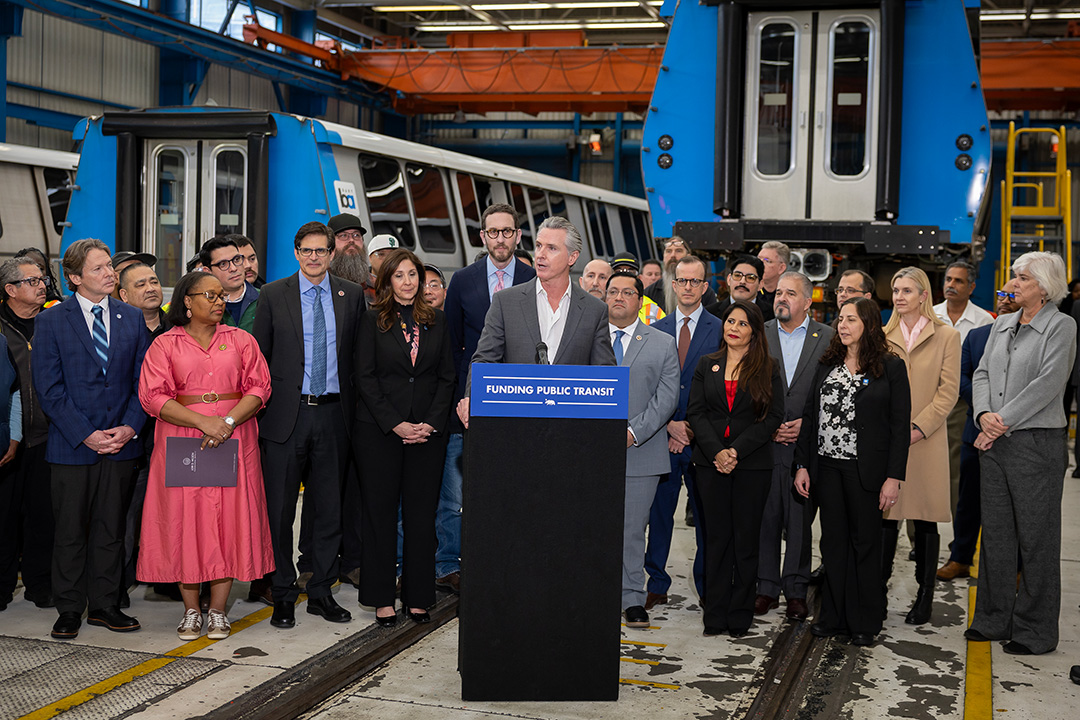
“[T]his agreement will help protect transit service for more than three million monthly riders,” said Governor Newsom at a mid-February press conference announcing the loan. “The benefits of a strong transit system are clear: growing ridership, cleaner air, and less congested roads. I’m proud of the progress the Bay Area transit service and operators are making on ridership recovery, and this loan will continue to build on that success as the region works together on long-term funding solutions.”
“This is a major victory for our region’s transit operators, workers, and the communities that depend on public transit to get to work and school,” said Senator Jesse Arreguín of the loan. Senator Arreguín was a key leader in the 2025 legislative effort to secure the initially-proposed $750 million loan for Bay Area transit operators.
Affected transit operators have expressed gratitude for the emergency loan’s approval. “We’re grateful to Governor Gavin Newsom and his administration for stepping in with the recently approved $590 million emergency loan to help prevent severe service cuts across the Bay Area. For AC Transit, this provides important short-term relief and helps keep our buses on the road for the riders who depend on us every day,” said Salvador Llamas, General Manager and CEO of AC Transit.
The loan includes a clearly defined repayment structure, a guaranteed revenue source to secure the loan and an agreed-upon interest rate of a 12-year repayment term, with interest-only payments during the first two years, repayment secured by the "revenue-based" portion of State Transit Assistance that goes directly to the transit agencies, and a variable interest rate tied to the state's Surplus Money Investment Fund, ensuring the state is fully repaid at the same rate it would have earned had the funds remained in state accounts.
Bay Area transit agencies have halted some proposed service cuts for now, but deficits will persist without another long-term funding source. The loan is a step in the right direction, but agency representatives acknowledge that longer-term concerns about funding remain.
“It’s important to be clear; this is a loan, not a grant. It must be paid back in full, and it does not solve our long-term funding challenges,” said Llamas of AC Transit. “AC Transit is still facing a $74 million operating deficit in the 2026–27 fiscal year. That’s why we’re continuing to work closely with local lawmakers and regional partners to identify lasting financial solutions. Our goal is simple: protect today’s service, repay these loans responsibly, and secure a stable, sustainable future for East Bay riders.”
Connect Bay Area proposes a regional tax measure for the November ballot
In October 2025, California lawmakers approved the Connect Bay Area Act, which authorizes a voter initiative to be placed on the November 2026 ballot in the counties of Alameda, Contra Costa, San Francisco, San Mateo, and Santa Clara to fund transit operations for Bay Area transit operators. The Act was authored by Senator Arreguín and Senator Scott Wiener
If approved, the initiative would create a 14-year long retail transaction and use tax administered by the Metropolitan Transportation Commission; the sales tax levy would be set at a half-cent increase in Alameda, Contra Costa, San Mateo, and Santa Clara counties, and at a one-cent increase in San Francisco.
The proposed tax is estimated to raise about $1 billion annually in order to prevent transit cuts, continue ongoing operations, and expand transit investment across the Bay Area, including over $260 million to the Santa Clara Valley Transportation Authority annually to expand and improve service.
However, Bay Area voters will only have the opportunity to vote on this long-term funding source if the measure qualifies for the ballot.
Public employees, including those of transit agencies, are prohibited by law from supporting or opposing proposed ballot measure campaigns.
The Connect Bay Area Transit Committee is comprised of labor, business, and transit advocates, including Bay Area Council, SEIU 1021, ATU 1555, SPUR, and SAMCEDA, alongside an advocacy council of more than 20 organizations representing transit, housing, environmental, equity, and senior and disability groups.
In order to qualify for the November 2026 ballot in the affected counties, proponents must gather at least 186,000 qualified signatures by June 6 of this year. Proponents are currently gathering signatures, which kicked off with January Day of Action rallies in five counties – Alameda, Contra Costa, San Francisco, San Mateo, and Santa Clara – where transit agencies would receive revenues if the measure passes. The measure requires a simple majority of votes for the tax to take effect.
According to Connect Bay Area spokesperson Jeff Cretan, signatures are being collected both by paid signature gatherers and volunteers: “Both programs are up and running, and we've got great energy going with our volunteer engagement efforts. They are out at transit stations, farmers markets and events all across the Bay Area. We are meeting our current pace to qualify, and we just need to keep at it to hit our goals.”
So far, Connect Bay Area has fundraised nearly $4 million from a mix of businesses, labor organizations, and philanthropy to support efforts to secure the qualification and ultimate approval of the measure by voters.
There is reason to believe that if the measure qualifies for the ballot, it could pass: Supporters cite recent polling showing that 59% of Bay Area voters support a proposed regional sales tax for public transportation.
Recent history shows that special tax proposals are frequently well-received. Voters approved California’s special tax proposals on the 2024 general election ballot more often than not, with 72 out of 108 passing, or about a 67% rate of success.
Nevertheless, with inflation squeezing consumers and affordability a top-of-mind concern in 2026, some voters might be concerned about the potential cost of the proposed tax increase.
That’s focusing on the wrong cost driver, said Cretan. “People would pay far more for one day's commute (bridge toll, gas, parking) than they would in a month of paying the modest sales tax increase.”
According to Cretan, relying on alternatives to public transit, such as Waymo’s autonomous vehicles or transportation network companies (TNCs) like Uber and Lyft, would result in additional drawbacks: more traffic congestion for road users, and more expensive for riders. “The 12-mile trip from downtown San Francisco to Berkeley in a TNC is 10 times the cost of the fare on BART.”
Ultimately, if voters don’t approve the measure and no other long-term funding source is identified, transit agencies could be forced to make dramatic reductions to services.
“BART staff and the BART Board of Directors are currently working to develop detailed plans to address our projected FY27 $376M deficit if a November 2026 funding measure fails, or no other operating revenue source is identified,” said Trost.
If no long-term funding source is approved, “this would negatively impact riders who depend on transit every day, push more people into cars, increase traffic and pollution, and could weaken the Bay Area’s economy,” said Cretan.
Those interested in learning more about the Connect Bay Area regional sales tax measure proposal can find more information at ConnectBayArea.com.